


The Story of Shaolin
BUDDISM IN CHINA
In 64 CE, Emperor Ming of the Eastern Han sent a delegation to the west to search out and study Buddhism. They returned after 3 years with two eminent Indian monks, along with Buddhist sutras and figures, on a white horse. He created a temple 100 km from Luoyang and named it the 'White Horse Temple'. This became a center of learning and Buddhist study. About 100 km away, in the center of China, was a mountain range that would come to fame some 440 years later.
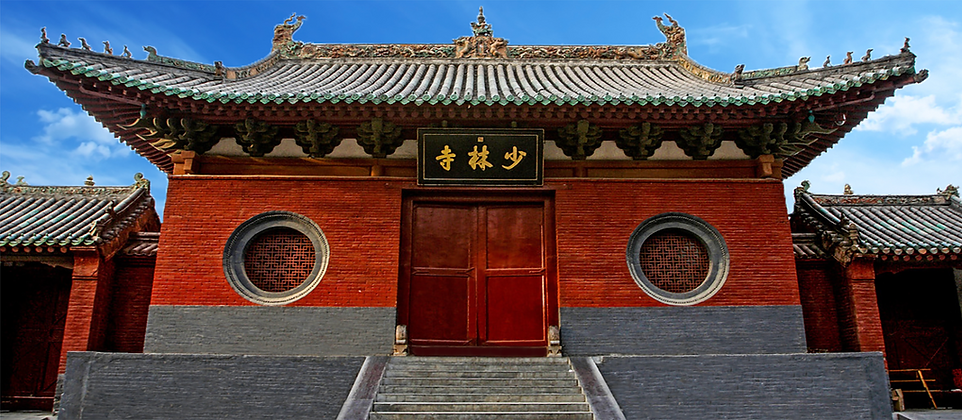
Establishment of Shaolin
Towards the end of the 5th century CE, an Indian warrior/Buddhist monk, Buddhabhadra (later renamed 'Batuo'), was traveling through China teaching Buddhism. He had a great heart and mind, helping and guiding anyone who wanted his help. Because Batuo impressed the Emperor with his wisdom and Buddhist interpretation, he was offered a permanent office and place at the palace. However, Batuo proposed that his teachings might be better served if he were in a more accessible place. The Emperor offered him several hectares in the province of Henan, in the Sacred Mountains on the side of Shao Shi (shi meaning mountain). They chose a spot in an area of lin (young/new trees) as the place for the temple. This came to be the name of the Shaolin (Sillum in Cantonese) Temple. While in the temple, Batuo encouraged the monks to follow a simple life of farming, literature, philosophy, and meditation. Their personal views on life were those of nonviolence, tolerance, honor, and humility.
TA MO'S TEACHINGS
In a small tribe of Southern India, a prince, Bodhidharma (Ta Mo), was born. He became a Mahayana Buddhist at an early age and, as part of his training, he practiced hard exercises and training in addition to meditation and study. In 527 CE, Ta Mo traveled east into China, preaching the ways of Mahayana Buddhism. Upon reaching the temple in Henan, he found the monks weak and without physical ability. Their pious lifestyle consisted of constant seated meditation and a great lack of physical activity (which left them weak and vulnerable if ever attacked).
Ta Mo then spent the next 9 years in a cave 30 minutes away from the temple, meditating on the problems within the Shaolin walls. Eventually, he developed a series of exercises designed to strengthen the monks physically as well as mentally. They were called "Muscle Change Classics," "Marrow Washing Course," and "The 18 Hand Movements of the Enlightened One." This marked the beginning of Shaolin Kung Fu (Kung Fu - hard work and perfection). The monks took Ta Mo's exercises and blended them with local self-

defense techniques, creating what was known as the 'Lo Han' style. From that moment on, the monks at the Shaolin temple dedicated themselves to the perfection of their fighting arts. Continuously upgrading and developing their system of self-defense, the monks added the techniques of Chin Na (joint locks), Shuai-Chiao (wrestling/throwing), and Qi gong (internal energy). As a result, the Shaolin monks were quickly recognized for their superior skills. It was said that a Shaolin monk was worth 1,000 soldiers.
CREATING A SHAOLIN MONK
With their superior reputation, a vast number of individuals wanted to be associated with the Shaolin temple. Thus, the Shaolin needed a way to separate those only wanting fame from their future monks. Provided that the applicants were accepted, training was very involved and rigorous for all monks.
Once accepted, they spent their first several years performing kitchen duties as well as other menial tasks, including the famous water carrying, sweeping, fixing, mending, serving, etc. Aside from these duties, they also received an outstanding education in calligraphy, basic math, Buddhism, poetry, history, and music (the 6 Noble Skills). It was a very hard life, but it sorted out the best for full training as a Shaolin monk. For those who successfully completed their 'kitchen' period, their next step was to obtain a mentor—a monk who would accept them and take them as a disciple. This was to ensure that the right-minded were chosen (not just tough individuals). The second phase of training would begin with greater focus Buddhism than ever

before. Aside from Buddhist studies, many Shaolin students had their areas of expertise—areas where they mastered an aspect of the 6 Noble Skills and other teachings. Shaolin monks that were chosen would be brought to the brink of exhaustion through their training. Records indicated a very tough regimen of physical and mental exercise with only 4 hours of sleep most nights, long runs before breakfast, very hard martial art exercises, Chi Kung, and endurance training on top of their Buddhist studies and obligatory daily meditations. This would go on for several years. Those who failed were not allowed to stay in the Shaolin Temple and were asked to leave. Those that completed the training were accepted, replacing the Shaolin monks who retired or were killed.
EVOLUTION AND EXPANSION
Many evolutions have taken place along the way with respect to the practice of Shaolin Kung Fu. Just to name a few, Chueh Yuan (a highly skilled martial artist) entered the Shaolin monastery wanting to further develop the Kung Fu training and fitness. He was responsible for revising the unstructured Kung Fu training into a structure of 72 fists and movements. He took his studies further and, with the help of a Master by the name of Pai Yu-feng, took the '18 Hands of Lohan' along with the '72 Fists', along with Pai Yu-feng's pressure-point grappling/wrestling techniques, and redeveloped the Shaolin '72 Fist Kung Fu' into 170 exercises. These exercises consisted of a mixture of striking and controlling, evading and countering, as well as the use of vital points in martial arts.
In 960 CE, Emperor Tai Tsu added to the art, creating several Kung Fu styles including 'Chang Chuan' (Long Fist), thus evolving the arts further. Emperor Tai Tsu was also a skilled disciple of the Shaolin Temple. His Long Fist style had very open, long movements, circular arm motions, and many leg attacks. Long Fist became a popular Kung Fu system among the people. Even the monks at the Shaolin Temple noticed the quality of this self-defense style and decided to add the techniques of the Long Fist style into their repertoire. During the Song Dynasty (1127–1279), Kung Fu animal styles began to flourish. With the Song Dynasty's support for martial arts, many Kung Fu styles came into existence—styles such as Rooster, Toad, and Dog. There were also others such as 10,000 Bees, Mantis, and Tiger. With Shaolin's system of learning from travelers, many of these styles found their way into Shaolin. Following these animal styles, a martial art expert named Zhue Yuen joined the Shaolin Temple to systematize the styles in the mid-1300s. Along with the aid of Li Sou and Bai Yu Feng (two other skilled martial artists), they redeveloped

the Shaolin Animal Kung Fu into the 5 Animal Fists: Tiger, Snake, Dragon, Leopard/Panther, and Crane (possibly even developing the 18 Hands of Lohan further into what we may call a combination of Tai Chi and Chi Kung). They also took Ta Mo's 18 Lohan techniques and increased them to 170. Bai Yu Feng is also credited with creating the 5 Ancestors' style. This style has 5 separate forms to create one system, which Bai Yu Feng took the best 5 styles (Crane style, Monkey style, Ta Mo Chi Gong, Tai Tsu Long Fist, and Lohan style) and blended them together to make one complete system. Although originally just physical exercise and Kung Fu, the 5 Animal style took on a life of its own. The Shaolin were able to discover and develop the 5 Animal Style system to be not just physical but also a personality style index—metaphors for human situation handling, interaction, problem-solving, planning, and much more. The Tiger was well suited to strong, big, and powerful practitioners who sought and were able to bring a quick end to conflict.

Their key was simplicity, directness, and an explosion of enormous power coupled with a very low threshold of pain. Leopards/Panthers were like small tigers; generally aggressive and dominant, but not using physical force and power, but mental cunning and strategies. These were the intelligent and manipulating martial art stylists. Crane Style was for small, non-aggressive persons who did not wish to fight or attack. This was not a style of winning but a style which created the environment for an attacker to lose. These practitioners needed to be agile, flexible, exact, and precise. Snakes were the people who turned their attackers into knots, using pressure points to disable and control their attackers. Snakes were technicians of human physiology and creating pain without damage. Dragons were those who mastered all and were able to avoid fighting without losing. It was the ultimate in Shaolin principles, almost not achievable; thus, the symbol of the Dragon was chosen.
In 1130 CE, General Yueh Fei created the 'Eagle Claw' system. He derived his newly found system by using principles he learned from Shaolin master Chou Ton and by his skills as an army general. The Eagle Claw system's strength lies within its Chin Na (grabbing and locking) techniques. He is also noted for creating the basic root of the internal art of Xing Yi.
In the late 1200s, Shaolin master Chang San Feng left the temple and headed for the Wudang Mountain, as he felt the techniques used by the Shaolin monks had become too hard, using too much brute force. Chang San Feng set out to soften the Shaolin technique. One day, Chang noticed a snake and a crane fighting. The snake used circular, coiling actions to elude the crane's attempts to catch it. The crane used its wings to fend off the snake's strikes. This fight had much impact on Chang's innovations of his Shaolin style. Chang then created what he called the 'Soft Fist' or 'Cotton Fist' style. This is what could be considered the earliest form of Tai Chi.
During the Qing Dynasty (1644–1911), Shaolin master Wang Lang created the 7 Star Praying Mantis by combining the techniques of 17 different Kung Fu styles. Also during this period, Shaolin Gee Sum Sim See laid the foundation for the Hung Gar style. Many other styles were created during this period including Mi Tsung Lohan, Choy Li Fut, Tien Shan Pai, Fu Jow Pai, Chen Tai Chi, and White Crane (just to name a few).
THE TEMPLE THROUGH TRAILS
Over time, the Shaolin Temple had experienced troubles. They were subject to the abolishment of Buddhism by the Northern Zhou Dynasty in 574 and 577, as Emperor Wu believed the temple had become too rich and powerful, thus confiscating their land.
During the Qing Dynasty, the Shaolin Temple became a threat to the Manchu rulers due to their resistance and influence. The Manchus did not want any symbol of resistance; thus, the Shaolin needed to be destroyed, as well as the minds of all who knew it, to stop them from passing on its extremely effective fighting style. The Manchus then forbade all martial arts practice in all of China (this law was still in place, nationally, for centuries). All Shaolin monks were disbanded and mostly killed, yet some escaped. It is believed that some Shaolin sought refuge, while some just simply migrated to other countries, sparking a martial arts style explosion in many oriental and Western countries, while others continued their resistance and taught Kung Fu for the sole purpose of fighting and defeating the Qings. These

individuals were the fathers of secret resistance organizations known as the 'Triads' (so named after a gift of a jade triangle from the Ming Dynasty Emperor to the Shaolin). Some just simply became anonymous citizens. Through the Tang Dynasty, the Shaolin monks were given back their temple and had permission to reopen. For their rescue of the Tang Emperor's son, the Shaolin monks were granted greater lands and regular funds. Although, this would not be the last time the monks were asked to use their superior skills to aid future Emperors.
They were asked to restore order in Fukien [Fujian], where pirates and the lawless controlled the area. After restoring order in Fukien, the Emperor was extremely happy, thus rewarding the Shaolin monks with an even greater area of land. Eventually, with Shaolin becoming so renowned, many young people wanted to become soldier monks. Shaolin seemed like the second center (aside from the Imperial court) of the Chinese universe.
In 1647, the Qing Emperor asked the Shaolin monks for help. The monks came and aided him. After their victory, the Emperor asked the monks to join his court. When they refused, he became upset and ordered the temple to be destroyed.
In 1927, the Shaolin Temple was destroyed again. This time, many historical books were burned, and almost all of the senior monks were killed. The monks who survived fled to Hong Kong, South America, Europe, North America, etc.
LEGACY TODAY
Despite its complex history, Kung Fu is still expanding and changing in the world today. In the present time, you can see variations in some of the styles as masters change their forms to meet today's needs.